
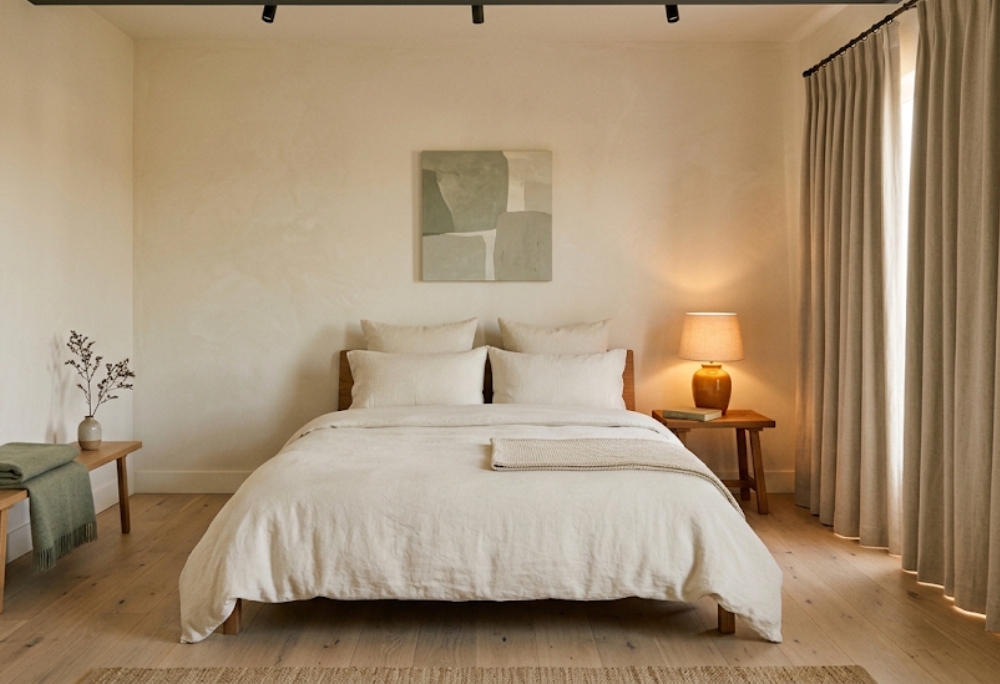
SLEEP LIKE A BABY: RENTER-FRIENDLY HACKS FOR THE ULTIMATE SLEEP SANCTUARY
Crystal Wong
Architect · Wellness-Based Design · Feng Shui
The room you sleep in shapes the quality of your rest — and you do not need to renovate it to change what it does.
Your bedroom should be your most restorative room — but when you are renting, it often arrives with thin curtains, a tired mattress, and the persistent hum of the street outside. The good news is that the changes with the most impact on sleep quality are also some of the simplest and most renter-friendly. This post walks through five evidence-informed adjustments you can make to the room you already have, without permission from your landlord and without spending a great deal of money. If the air itself feels stale or heavy, it is worth pairing these changes with steps to improve your rental’s indoor air quality — sleep and air quality are closely linked.
- Blackout curtains and light control — how to manage light exposure without drilling a single hole
- Natural-fibre bedding — breathable fabrics that help your body temperature self-regulate through the night
- Sound environment — using white noise and smart speakers to create acoustic calm
- Temperature regulation — portable tools for keeping your sleep zone in the optimal range
- Bedroom declutter and Feng Shui — clearing the space so the mind can settle before sleep
Principle 1 · Block out the light
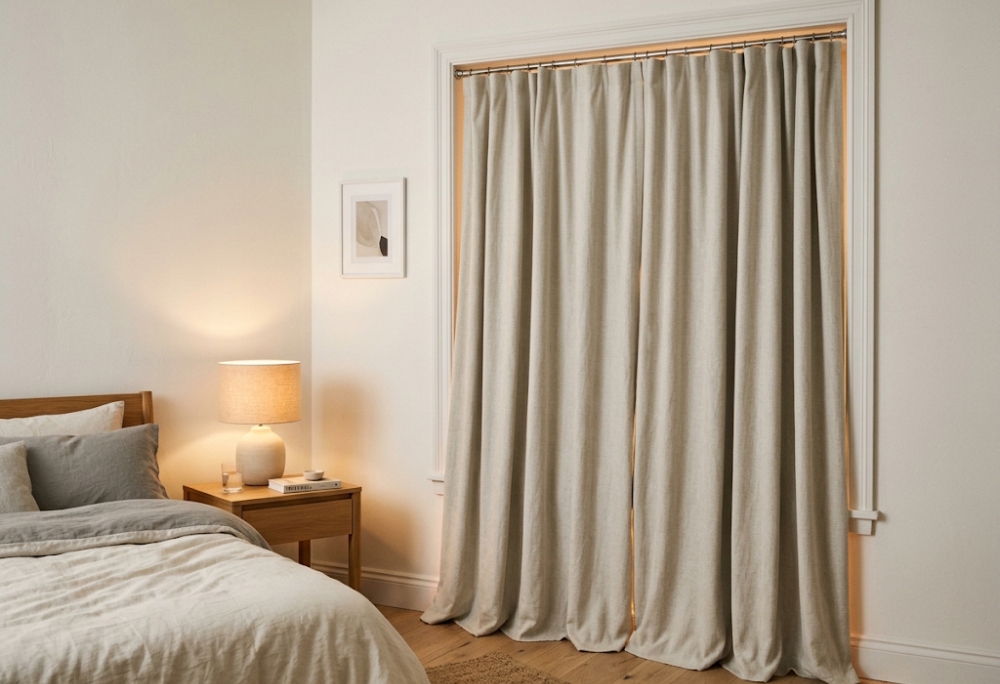
The brain registers light as a signal to stay awake — even the faint glow of a streetlamp beneath a thin curtain can delay melatonin production and fragment your sleep cycles. Research on how light exposure affects melatonin and sleep shows just how sensitive the body’s internal clock really is. Research on how light exposure affects melatonin and sleep shows just how sensitive the body’s internal clock really is. For renters, the fix does not require drilling: a tension rod fitted inside the window frame holds a full-length blackout curtain without touching the walls or leaving any marks. Adhesive blackout film is a useful alternative for awkward windows that are difficult to dress.
- Blackout curtains on a tension rod — fits inside the frame, no fixings, no damage
- Adhesive blackout window film — bonds to glass and peels away cleanly when you move out
- Check that the fabric extends past the window edges on all sides to eliminate light gaps
💡
Pro tip: Layering a sheer voile behind a blackout panel gives you two settings — soft diffused morning light or complete darkness — without needing to change anything structurally.
Principle 2 · Choose natural-fibre bedding
The materials against your skin for eight hours affect how well your body temperature regulates through the night. Synthetic fabrics tend to trap heat and moisture; organic cotton and bamboo breathe naturally, wick moisture away, and feel gentle on sensitive skin. A peer-reviewed look at why natural fibres support better sleep backs up what many people notice the first night they switch. If replacing your mattress is not realistic right now, a quality mattress topper is one of the most effective single upgrades available to renters — it changes the sleep surface entirely without touching what is underneath.
- Organic cotton sheets — breathable, hypoallergenic, and free from chemical finishes
- Bamboo duvet covers — temperature-regulating and naturally antibacterial
- A wool or natural-latex mattress topper resets the sleep surface without replacing the mattress
Feng Shui note: In Feng Shui, the bed holds the most significant energy in the home. Natural fibres support the flow of restorative yin energy in the sleep space — the quality of what surrounds your rest is not separate from the quality of the rest itself.
Principle 3 · Create a calming sound environment
Sound has a direct effect on how deeply we sleep — and in most rentals, we have very little control over what comes through the walls, windows, and ceiling — though there is still plenty you can do to reduce noise in a rented apartment before you touch a single sound machine. A dedicated white noise machine generates a consistent ambient sound that masks irregular disturbances without requiring actual silence. Most smart speakers already include sleep sounds as a built-in feature, so if you own one, you may already have everything you need.
- White noise machines — mask inconsistent sounds that fragment light sleep cycles
- Smart speaker sleep sounds — a free alternative using what you likely already own
- Nature sounds — rain, ocean, river — are effective alternatives to pure white noise for lighter sleepers
Pro tip: Place your white noise device between you and the primary source of sound — a shared wall, the door, or the window — for the most effective masking coverage.
Principle 4 · Regulate your room temperature
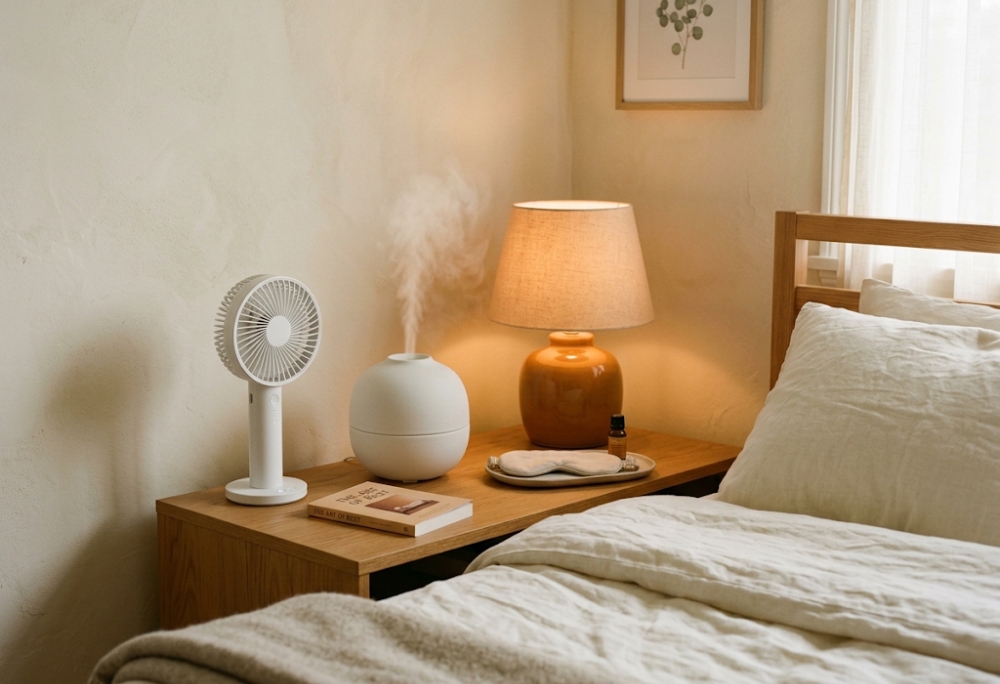
Research consistently places the ideal sleep temperature between 15–19°C (60–67°F) — cool enough for the body to drop its core temperature, which is one of the key signals that it is time to sleep. A closer look at the ideal sleep temperature and its effect on rest explains why this range matters so much for deep sleep. For renters without control over central heating or air conditioning, portable tools close this gap effectively and can be moved with you when you leave.
- Portable fan — circulates air, cools the room, and adds a secondary layer of white noise
- Portable humidifier — restores moisture in over-heated or dry environments; clean it weekly
- Lightweight wool or cotton bedding allows you to adjust through the night without waking fully
Pro tip: Position your fan to draw cooler air in from a window rather than simply recirculating warm room air — especially effective in warmer months.
“The bedroom you sleep in is not decoration — it is infrastructure for the rest your body needs to restore itself.”Crystal Wong · Real-Arch Design
Principle 5 · Declutter the bedroom and simplify the space
Visual complexity keeps the nervous system in a low-level state of alertness. Work items, screens, piles of clothing, and overfull surfaces all signal activity and incompletion — the opposite of what the brain needs to transition into rest. As an architect, I treat the bedroom as a yin space: calm, contained, and free of anything that competes with restoration. This does not require a renovation. It starts with what you remove — the same philosophy behind how to create a calm wellness corner in your rental.
- Move work items and screens out of sight — or ideally, out of the room entirely
- Keep surfaces minimal — two or three intentional objects, nothing unresolved
- Switch to renter-friendly lighting for a healthier home — warm-toned, low light in the hour before bed — overhead cool white signals daytime to the body
Feng Shui note: In Feng Shui, the bedroom should contain nothing that competes with rest. Mirrors facing the bed, screens left on standby, and clutter stored beneath the bed are all considered disruptive to restorative energy. Start with one small clearing and notice what shifts in how you feel the next morning.
Your rental bedroom can be a place of genuine rest
Sleep is not a luxury — it is the process through which the body repairs itself, consolidates memory, and regulates mood. The room where that happens deserves intention. As an architect, I have seen how small changes to the sleep environment — a curtain, a fabric, a sound — compound quietly into real differences in how people feel during the day. None of the adjustments in this post require permission from a landlord, a renovation budget, or a complete room overhaul.
Start with one change from this list. Observe what shifts. The room you already have is ready to support you more than it currently does — it is simply waiting for a little attention.
Ready to design a bedroom that actually helps you rest?
What would it feel like to wake up genuinely restored — in the rental you already live in?
Crystal works with renters and homeowners to design sleep-supportive environments that work with the space they have. A consultation is the first step toward a bedroom that truly supports your health.
Book a Consultation