Episode 26 · Wellness Design

How to Design a Bedroom That Actually Supports Better Sleep

Sleep Design Bedroom Wellness Home Healthy Space
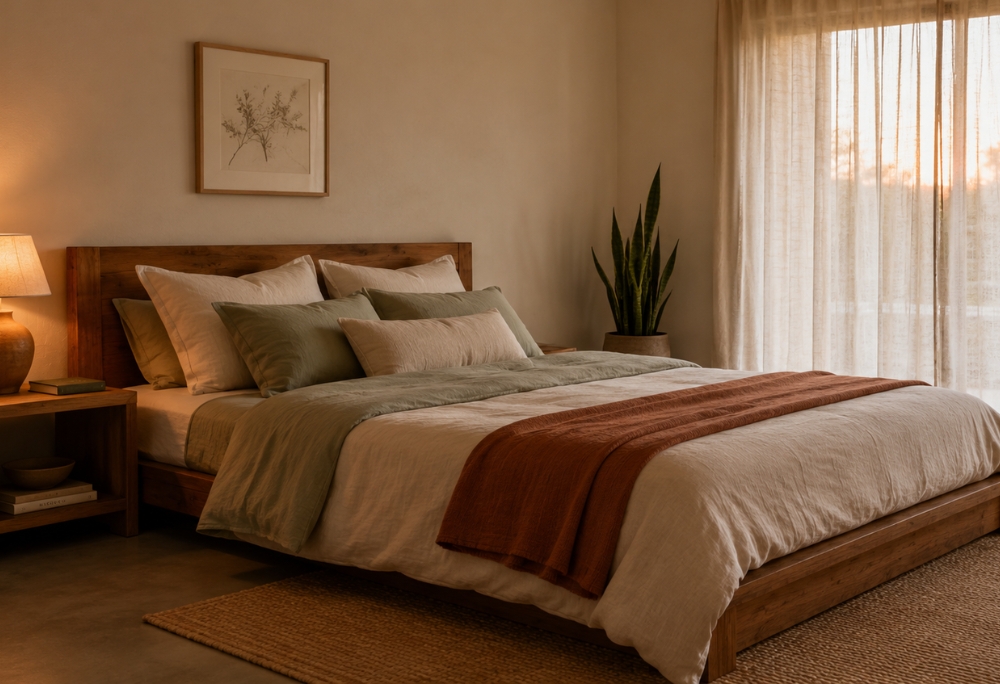
A calm, simply styled bedroom with warm lighting, natural linens, and minimal furniture

A bedroom designed for sleep feels different the moment you walk in. That feeling is not an accident.

Most people design their bedroom for how it looks. But the bedroom is not a showroom — it is a recovery space. When you design it for how it needs to function, sleep improves naturally. Here is what that looks like in practice.

In This Post
  1. Bed placement — why position affects how secure and restful you feel
  2. Light control — how to layer light for evening wind-down and morning wake
  3. Temperature, airflow, and sound — the three sensory conditions that shape how deeply you sleep
  4. Materials and colour — what the room is made of, and what your eyes rest on
  5. What to remove — the bedroom is not a home office, a gym, or a storage unit

Principle 1 · Choose a calm bed position

In architecture and Feng Shui, bed placement follows a consistent logic: the bed faces the door without sitting directly in line with it. This gives you a clear sightline to the room's entry while keeping you out of its direct energy flow.

  • Place the bed against a solid wall
  • Keep a clear view of the door
  • Avoid lining the bed up with the door

Feng Shui note: The "command position" — bed facing the door, against a solid wall — is one of the most consistently recommended placements across Feng Shui traditions. It creates a felt sense of safety that supports deeper rest.
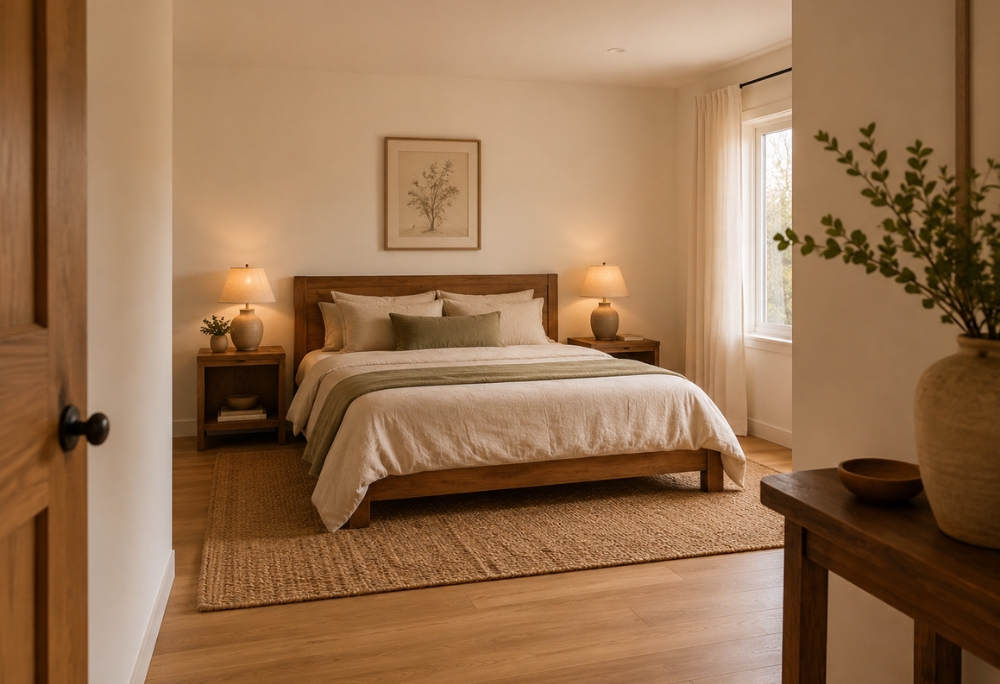
A bedroom layout viewed from the doorway showing the bed placed against a solid wall, headboard centred, with a clear diagonal sightline to the door — the Feng Shui command position

The "command position" — bed against a solid wall, with a clear sightline to the door — creates the felt sense of safety the body needs to rest deeply.


Principle 2 · Layer your lighting for sleep

Sleep is regulated by light. Bright overhead lighting at night suppresses melatonin and delays sleep onset, while warm, low-level lighting signals the brain to wind down. The bedroom needs both an evening mode and a morning mode.

  • Use dimmable warm bulbs in the evening
  • Add blackout curtains or layered blinds
  • Keep a warm bedside lamp within reach
💡

Design note: Layered lighting is one of the most effective and affordable changes you can make to a bedroom. A single dimmer switch and one warm bedside lamp can meaningfully change the quality of your evenings — and your sleep.
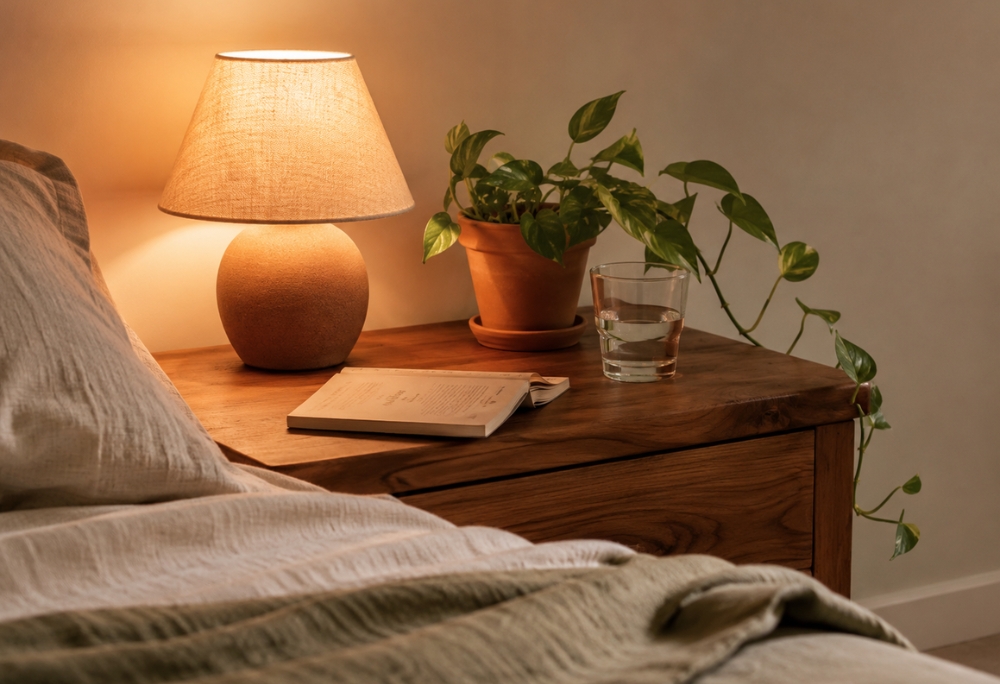
A close-up of a wooden bedside table with a warm-toned ceramic lamp glowing soft amber, a folded linen edge of bedding visible, a small terracotta pot with a trailing plant, an open paper book face down, and a glass of water

A single dimmer switch and one warm bedside lamp can meaningfully change the quality of your evenings — and your sleep.


Principle 3 · Get the temperature and air right

The body's core temperature drops naturally during sleep, and the room needs to allow that to happen. Sleep research points to 16–19°C as the optimal range, alongside good airflow and a quiet, low-stimulation space.

  • Keep the bedroom cooler than other rooms
  • Choose natural fibre bedding that breathes
  • Crack a window or add a fan
🌿

Wellness note: A bedroom that feels stuffy or airless can contribute to restless sleep even when other conditions are right. Air quality and airflow are foundational — and often the most overlooked elements of bedroom design.


Principle 4 · Choose calming materials and colours

The bedroom is where you spend the most concentrated, uninterrupted time, which makes the materials around you matter more here than anywhere else. Colour matters too — busy, high-contrast environments keep the nervous system mildly activated, even when you're not looking directly at them.

  • Use low-VOC paint throughout the room
  • Choose solid wood over MDF furniture
  • Stick to warm neutrals over cool tones

"The bedroom does not need to be minimal. It needs to be calm. Those are not the same thing — but calm is always the goal."
Crystal Wong · Real-Arch Design

Principle 5 · Keep the bedroom for rest only

The bedroom accumulates function over time. Work equipment, exercise gear, and storage overflow all train the brain to associate the space with activity rather than rest. The clearer its purpose, the stronger the sleep association becomes.

  • Move work gear out of the bedroom
  • Clear exercise equipment from the space
  • Leave screens and tasks outside the door
💡

Simple reset: If your bedroom has accumulated multiple functions, pick one item to remove or relocate this week. The cumulative effect of small, consistent edits to the space will be noticeable within days.


Design the Room Your Sleep Needs

Better sleep is rarely just a sleep problem. It is often a design problem. When the bedroom is set up to support rest — through placement, light, material, air, and simplicity — the body responds. Not because it is magic. Because design and biology work in the same direction.

Start with one principle. The one that resonates most. Then let the room do its work.

Ready to Design a Bedroom That Actually Helps You Rest?

Your bedroom should be the most intentional room in your home — not the most neglected one.

Crystal works with clients to create sleep-supportive spaces that are also beautiful, calm, and deeply personal. If you are ready to invest in your rest, start here.

Book a Consultation

Leave a Comment

Your email address will not be published. Required fields are marked *

PROJECT: Aldea ADU

Type | ADU
Date Completed | June 2024 

PROJECT: Hesby Residence

Type | Residential Addition & Complete Remodel
Date Completed | Oct 2024 

PROJECT: Sunset Olive Oil

Type | Industrial Food Processing
Date Completed | March 2023 

PROJECT: Ogden Residence & ADU

Type | Residential Historic Restoration & ADU
Date Completed | December 2024 

PROJECT: Lab 5 Gardena

Type | Sports
Date Completed | January 2023 

PROJECT: Newville ADU

Type | ADU
Date Completed | December 2024 

PROJECT: Malibu Eco

Type | Hotel
Responsibility | Conceptual Design
Photo Credits | Egan Simon Architecture

PROJECT: Transtopia

Type | A Thesis Project

PROJECT: Vendome Palms

Type | Multi-Family Residence/Affordable Housing
Date Completed | December 2011
Responsibility | Construction Document to Construction Administration
Photo Credits | Egan Simon Architecture

PROJECT: The Courtyards

Type | Multi-Family Residence/Affordable Housing
Date Completed | November 2010
Responsiblity | Conceptual Design to Construction Document
Photo Credits | Egan Simon Architecture

PROJECT: Step Up on Vine

Type | Multi-Family Residence/Affordable Housing
Date Completed | January 2013
Responsibility | Conceptual Design to Construction Administration
Photo Credits | Egan Simon Architecture

PROJECT: Roman’s Carving Kitchen

Type | Restaurant
Date Completed | December 2017
Project Architect | Alain Giaimo
Responsibility | Construction Document to Permit

PROJECT: Beach Cities Cryotherapy

Type | Retail/Crytotherapy
Date Completed | May 2016

PROJECT: Mod’s Hair

Type | Retail/Hair Salon
Date Completed | January 2017

PROJECT: Lab Five Soccer Center

Type | Sport
Date Completed | June 2020

PROJECT: Pitchoun Bakery @ DTLA

Type | Bakery/Bar/Restaurant
Date Completed | April 2015
Photo Credits | Urban Daddy, LA Eater

PROJECT: South Bay Community Church

Type |Church Interior Concept Design
Date Completed | January 2013

PROJECT: Mulholland Security Headquarter

Type | Showroom/Office
Date Completed | August 2013

PROJECT: Dickey’s Barbecue Pit in Lake Forest
Type | Restaurant
Date Completed | October, 2016

PROJECT: Please Do Not Enter
Type | Retail Art Gallery

Date Completed | May 2015
Photo Credits | Please Do Not Enter

PROJECT: Varga Store Type | Retail Store Date Completed | October 2015
Photo Credits | Varga Store

PROJECT: Leimert Park Eatery

Type | Restaurant/Bar/Bakery Conceptual Design
Date Completed | January 2016

PROJECT: Cheviot Residence

Type | Residential Addition

Date Completed | June 2020
PROJECT: St Clair Residence

Type | Residential Addition
Date Completed | December, 2017

PROJECT: Sunrise Olive Oil Mill

Type | Industrial Processing Mill
Date Completed | February 2019